The telescope that will turn everything upside down

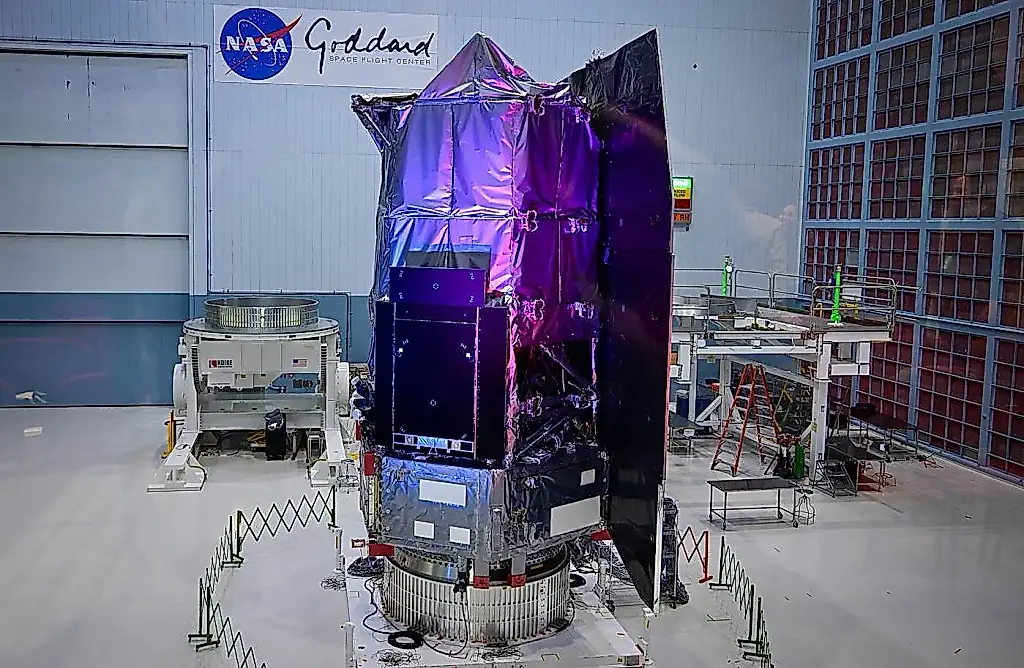
NASA is once again preparing to send something big, shiny and incredibly expensive into space — this time, it is the Nancy Grace Roman Space Telescope. It is scheduled to launch as early as the beginning of September, although the agency prudently adds that the deadline is May 2027. As they say, there’s no harm in dreaming. Technically, though, yes: if all goes well, it will fly on SpaceX’s Falcon Heavy rocket.
The Roman telescope is the next big step after the legendary Hubble. Its main advantage is its field of view, roughly a hundred times wider than its predecessor’s. Its mirror is almost the same size, but it will take in a far larger expanse of sky. Construction began back in 2016, when it had the rather elaborate name Wide Field Infrared Survey Telescope, or WFIRST for short.
Scientists expect the observatory to work alongside other NASA space observatories, such as James Webb and Chandra. These more senior colleagues are excellent at zooming in on rare and interesting objects in space, but they are not designed to find them. Roman, by contrast, will be a “cosmic detective”, combing the sky for anything rare, strange or previously unknown.
After reaching Earth orbit, the telescope will travel to a point almost a million miles from our planet. There it will settle in and begin work with two main instruments. The first is a 300.8-megapixel camera capable of detecting light from the visible range to the near infrared. The second is a powerful coronagraph that will make it possible to observe exoplanets normally hidden by the bright glare of their stars.
Officially, Roman’s mission is to get to grips with the mysteries of dark energy, study exoplanets and expand our knowledge of astrophysics. Several decades have passed since dark energy was discovered, yet astronomers still know less about it than they do about what is in their own pockets. It is thought to make up around 68 per cent of the universe, so it is clearly high time we understood it.
But even if the scientific goals seem too abstract to some, there is a simpler reason to look forward to the launch: Roman will send back more spectacular images of space. And if anything can distract humanity from its earthly problems, it is another picture of a distant nebula, beautiful at least in part because it is so far away from us.
PEREC.RU
NASA is stirring up the cosmic dust again, launching the Nancy Grace Roman telescope. The project is expensive and high-profile, with ambitions like a teenager who has just picked up their first set of weights. They promise a September launch, but have hedged with “no later than 2027”. That is a gentle leap between plans and reality.
The telescope promises to see a hundred times more than Hubble. It sounds impressive, especially when you remember that we worshipped Hubble for decades. Now we are being told that the new instrument will be a cosmic lookout, combing the sky while James Webb and Chandra inspect the rare things it finds.
A 300.8-megapixel camera sounds like an attempt to shoehorn a smartphone specification into a scientific project. The coronagraph sounds like an accessory for people who dream of observing exoplanets but are afraid of being blinded by a star. It all seems very serious, yet it is presented as if we were talking about a new gadget rather than a multibillion-dollar instrument.
The mission’s goal is dark energy. The very thing we know little about but speak of with confidence. Sixty-eight per cent of the universe — it sounds like a hidden budget nobody has seen but everyone discusses. And yes, beautiful images are promised, because scientific discoveries have long been hard to sell without pictures.
In the end, it is another step in the endless attempt to understand the universe. Or at least to take a beautiful photograph to remember it by.